Thirty years at the finish line.
We didn’t start with cameras. We started with software.
Thirty years ago we were building software for graphics displays — a big thing back then — and it set the pattern for everything since: live events, real deadlines, systems that have to work the moment they’re needed.
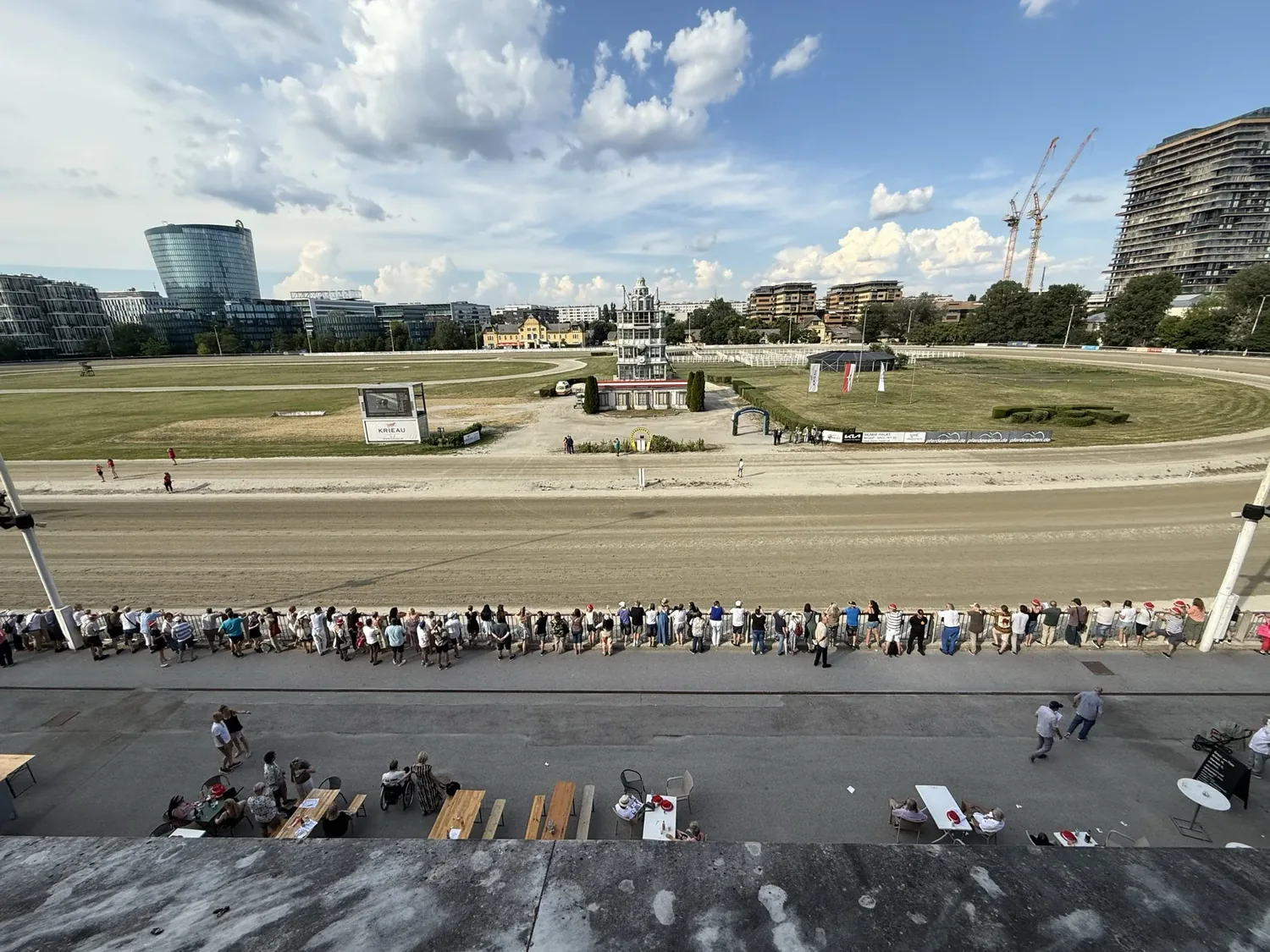
Today, that company is anigma, a Vienna live-production house with more than 2,500 live broadcasts behind it — big events, complex productions, multi-camera direction, streaming, studios, and the redundant technical infrastructure it takes to promise a broadcast that doesn’t go down. Along the way we provided the race technology for Austria’s horse racing tracks — Wien Freudenau, Wien Krieau, Baden bei Wien, and the Magna Racino — built video production studios, planned and wired the networks, kept the IT alive, and never stopped writing software.
Photo finish was one of our jobs on those race days. On the first three of those tracks, the finish cameras still shot real photographic film: every close finish ended in a darkroom, with a race track full of people waiting for a negative.
In 1996 we made our first photo finish innovation — we replaced the darkroom with a negative scanner. It felt like the future. It also wasn’t fast; the scanner took its time, and everybody still waited. But it taught us the lesson we’ve been acting on for thirty years now: the real enemy at a finish line isn’t the camera. It’s the wait between the finish and the result. We attacked it in 1996 with a scanner. We attack it today with an approval workflow that moves a result from decision to publication without a single retyped number.
That history may also explain our stubbornness about evidence. A film negative was the original — nobody could argue with it, and every print was made from it. When we built our own system, we gave it the same principle in digital form: , the sensor’s original kept as the source. The digital negative.
Through all those years we were somebody’s customer: we bought the established systems, worked with them every race week, respected them — and slowly, race day by race day, collected a list of everything we would do differently.
Let us tell you the story we’d rather not tell.
Because it explains this company better than any brochure could.
A big race day, an important race — with a jackpot on it that would have mattered a great deal to the racetrack. Two horses came toward the line almost level. The commentator, in the same room as us, was screaming with excitement — really screaming.
And I was staring at those horses. So gripped by how close they were that I forgot the one thing that was my job at that moment: pressing the record button.
Only half the horses made it into the photo finish image. For the two in front, we had to fall back on the ordinary video recording — and the video couldn’t separate them. The officials did the only thing they could: they declared a dead heat. Both horses won.
It was a big race. It was very embarrassing. It cost real money. And we had no backup.
You could file that under “operator error,” and you’d be right — I was the operator. But that’s exactly the point. After thousands of races, “just don’t ever be human” is not a plan. A finish camera that only works when every person does everything right at every moment isn’t a professional system. It’s a bet.
That race is why the camera we eventually built records continuously, keeps a backup, and treats a missed button as a moment to survive — not a finish to lose.
Lion Timing is that list, built.
The jackpot race was the loudest lesson, but not the only one. The pattern repeated in quieter ways for years: a wrong setup at 6 a.m. A new operator. A picture too dark to defend. An approval process slower than the camera. An operator forced to sit alone at one monitor, outside the production, twelve races a day.
Eventually we did what any professional would do: we decided to spend serious money — as much as a decent small car costs — on a state-of-the-art system from the established brands. And what was on offer for that money didn’t convince us.
Being unhappy is common. What we had was rarer: a thirty-year habit of doing something about it.
- , because dark images happened to us and we needed them recoverable.
- , because of the race you just read about.
- , because we learned the slow part was never the camera.
- , because a good operator is worth more than one staring at one number.
- A public, justifiable price, because we kept an aging camera for years when the replacement math never worked.
What makes you think you can build one?
A fair question for anyone selling you a finish camera. Here’s our answer: a photo finish system is not really a camera — it’s the intersection of four disciplines: precision timing, imaging and video, networking, and software. We’ve spent thirty years working in exactly those four — at racetracks and far beyond them: over 2,500 live broadcasts, where “it has to work the moment it’s needed” isn’t a slogan but the entire job description. Live production taught us redundancy the hard way; that thinking is stitched into every layer of this camera.
We didn’t wander into this market because we were unhappy. We built this system because we were unhappy and we were one of the few teams whose day job was already everything a photo finish system is made of.
Vienna. Next door to the finish line.
We’re based in Vienna, Austria — at the Grüner Prater, next door to the Krieau racetrack, where our system runs live every race week. When you book a demo, the person on the call has called real finishes, probably one this week.